EARLY BIRD! Enduring France

TRIP TYPE
Summit

DURATION
8 Days

DESTINATION
France
Why Join This Mont Blanc Climb? Our Mont Blanc Summit Course is designed to offer one of the safest and most complete ways to climb Mont Blanc. Led by IFMGA certified guides, each ascent is paced to your ability and timed for the most stable early and late season conditions, with August removed entirely for safety. You receive full expedition support from our coordinator team, trip photography that captures your journey, and a welcoming LHO community. If conditions make the Mont Blanc summit unsafe, we provide flexible alternative peaks at no extra cost so you still return with a meaningful alpine achievement.
1
The safest Mont Blanc experience, designed around real conditions, expert IFMGA guidance, and early and late season dates for maximum stability.
2
A complete 8 day progression that builds your skills, confidence, and acclimatisation through guided training, glacier practice, and a clear day by day approach.
3
A supportive community experience with expedition coordinator care, trip photography, and a team that knows you, guides you, and celebrates your journey.


2026
DATE & STATUS
PRICE
TEAM LEADER
AVAILABILITY
2027
DATE & STATUS
PRICE
TEAM LEADER
AVAILABILITY
د.إ1,884,510,934,726,200,000,512
د.إ1,733,750,059,948,100,026,368
د.إ1,884,510,934,726,200,000,512
د.إ1,733,750,059,948,100,026,368
د.إ1,884,510,934,726,200,000,512
د.إ1,733,750,059,948,100,026,368
د.إ1,884,510,934,726,200,000,512
د.إ1,733,750,059,948,100,026,368
د.إ1,884,510,934,726,200,000,512
د.إ1,733,750,059,948,100,026,368
د.إ1,884,510,934,726,200,000,512
د.إ1,733,750,059,948,100,026,368
د.إ1,884,510,934,726,200,000,512
د.إ1,733,750,059,948,100,026,368
د.إ1,884,510,934,726,200,000,512
د.إ1,733,750,059,948,100,026,368
د.إ1,884,510,934,726,200,000,512
د.إ1,733,750,059,948,100,026,368
د.إ1,884,510,934,726,200,000,512
د.إ1,733,750,059,948,100,026,368
WHAT'S INCLUDED IN THIS TRIP
WHAT'S NOT INCLUDED IN THIS TRIP
DAY 1: WELCOME TO EPIC CHAMONIX
Your Mont Blanc adventure begins as you arrive in the Chamonix Valley, the heart of alpine mountaineering and the perfect base for your climb. If you’re flying into Geneva Airport, our trusted transfer partners will meet you and bring you directly to our hotel in Chamonix. Airport transfers are included between 6:30 am and 7:30 pm. To ensure a smooth arrival, please share your flight details with LHO Base Camp ahead of time.
If you’re joining us directly at the hotel, your LHO Team Leader will be there to welcome you. Hotel check in usually begins at 3 pm, but guests arriving earlier can store their bags and explore Chamonix. Your Team Leader will share a curated list of recommended spots around town, from scenic walks to cafés and gear shops.
For those needing to rent equipment, we highly recommend arriving early on Day 1. Gear shops in Chamonix typically close by 7 pm, and having everything ready tonight ensures we can make an early start tomorrow. Gear checks will be coordinated throughout the day to make sure everyone has what they need for glacier travel and the high alpine environment.
At 7:30 pm, the full team gathers for a welcome dinner and the first official briefing of the expedition. This is your chance to meet your fellow climbers, your Team Leader, and your lead IFMGA mountain guide. You’ll review the plan for the week, discuss safety considerations, and run through the essential preparation for the days ahead.
If you’d like to begin learning about the mountain before your climb, we recommend reading our Definitive Guide to Climbing Mont Blanc where you can explore topics such as the safest climbing seasons, acclimatisation strategies, and what to expect on summit day. Linking to the guide here helps you prepare mentally and physically for the journey ahead.
DAY 2: ONTO THE VALLEE BLANCHE
Our first full day together marks the beginning of your high-altitude training and acclimatisation for climbing Mont Blanc. After breakfast, we leave the hotel and travel through the Mont Blanc tunnel to Courmayeur. From there, we ride the Skyway Monte Bianco to Punta Helbronner, one of the most spectacular viewpoints in the Mont Blanc range and an essential gateway for glacier travel and early mountaineering training.
Once we reach the top station, we take the elevator down and follow the enclosed walkway to the Torino Hut, our base for the next two nights. This hut sits at an ideal altitude for acclimatisation and offers immediate access to the glacier, making it one of the best locations in the Alps to begin developing the core skills needed for a safe Mont Blanc ascent. Its position allows us to train and climb without long approaches and provides several nearby peaks for warm up objectives.
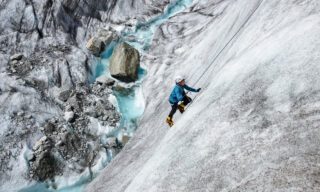
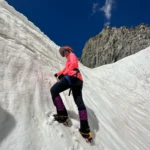
After checking in and enjoying a light snack, we step onto the glacier for our first technical session. This is where you begin learning the essential skills for climbing Mont Blanc, including crampon techniques, ice axe handling, rope work, and the fundamentals of safe glacier movement. These skills form the foundation of every successful Mont Blanc climb via the Goûter Route.
In the evening we return to the Torino Hut for dinner and a short briefing about the next day’s plan. You will have time to rest, hydrate, and settle into the rhythm of high-altitude life as you prepare for the climbs ahead.
If you would like to understand more about the glacier skills taught on this day and how they fit into the wider preparation for climbing Mont Blanc, you can explore the training and acclimatisation section in our Definitive Guide to Climbing Mont Blanc.
DAY 3: GLACIERS & SUMMITS
Distance: 4.5 KM | Ascent: 362 | Descent: 363 | Max Altitude: 3,375 M
Our second day in the high mountains begins with an unhurried start that allows everyone to settle into the rhythm of alpine life. Breakfast is served at 7 am and we aim to be outside by 9 am if the weather allows. Today is one of the most important stages in the Mont Blanc itinerary because it focuses on the core skills required for climbing Mont Blanc safely and confidently.
Once we step onto the glacier, we begin training in rope teams and learn how to move efficiently across glaciated terrain. Your guides introduce the techniques used to navigate crevasses, manage mixed snow and ice and maintain steady progress as a team. This is also our first summit opportunity of the trip. Depending on conditions, we often climb Petit Flambeau or La Toule, two classic training peaks that help build altitude awareness and essential alpine footwork.
The pace is thoughtful and supportive with plenty of time for hands on learning. Many community members say this is the moment when the experience begins to feel real. The glacier becomes familiar, the gear feels natural and the skills gained during training start to come together with purpose.
We carry packed lunches so we can spend a full day on the glacier, taking breaks in incredible surroundings. In the afternoon, we return to the Torino Hut for dinner and rest. This day plays a key role in your acclimatisation and prepares you for the bigger objectives ahead.
If you would like to explore the skills we practice on this day, such as crampon techniques, glacier navigation and early acclimatisation, you can read more in our Definitive Guide to Climbing Mont Blanc.
DAY 4: THE RIDGES OF THE MARBREES TRAVERSE
Distance: 3.4 KM | Ascent: 231 M | Descent: 265 M | Max Altitude: 3,535 M
Our final morning at the Torino Hut begins with one of the most enjoyable training climbs in the Mont Blanc region. After breakfast, we set out across the Glacier du Géant toward the Aiguilles Marbrées, a beautiful granite ridge positioned between the Dent du Géant and the Grandes Jorasses. This objective is close to the hut, offers reliable conditions, and provides an excellent combination of glacier travel, ridge climbing and exposure at altitude. It is an ideal progression for anyone preparing for climbing Mont Blanc later in the week.
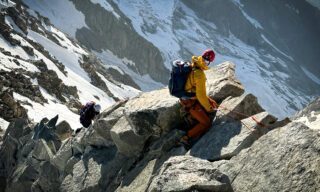
We begin by crossing the glacier and gaining the east ridge. The ascent is steady and engaging, with a mix of easy scrambling and movement over rock and snow. If conditions allow, we continue past the summit and follow the ridge toward the south side, where a short abseil provides a more direct return route and reduces the distance we would otherwise travel across the glacier. If weather or snow conditions do not support the full traverse, we simply retrace our ascent route.
We usually return to the Torino Hut in time for lunch. After gathering our equipment and taking a short break, we board the cable car and descend to Courmayeur before driving back to Chamonix. The night is spent at our hotel in the valley where rest and recovery become the priority. Dinner is hosted at a local restaurant or at the hotel, giving the team time to relax and prepare for the next stage of the Mont Blanc itinerary.
If you would like to understand how training peaks like the Aiguilles Marbrées support acclimatisation and technical readiness for climbing Mont Blanc, you can explore these topics in our Definitive Guide to Climbing Mont Blanc.
DAY 5: DEPARTING FOR THE MONT BLANC
Today marks the beginning of the Mont Blanc summit phase. We start later than usual, often around midday, to allow for rest and recovery before the climb. From Les Houches, we take the Bellevue cable car and continue on the Mont Blanc mountain train to Nid d’Aigle. This is one of the classic starting points for climbing Mont Blanc and offers spectacular views of the Bionnassay Glacier and the surrounding peaks.
From Nid d’Aigle, we begin a steady three hour trek toward the Tête Rousse Hut. This approach does not require technical equipment and provides a smooth progression in altitude. Along the lower slopes it is common to see mountain goats grazing on the rocky terrain, one of the many unique experiences of the Mont Blanc itinerary. We stop for a picnic lunch near the Rogne Forestière hut before continuing toward the Tête Rousse glacier. Crossing the glacier rarely requires technical gear at this stage of the season, although conditions vary year to year.
After checking in at the Tête Rousse Hut, the focus shifts to preparation. The guides and your LHO Team Leader meet with the hut guardian to review weather and conditions before finalising the plan for the Mont Blanc summit attempt. A detailed briefing takes place after dinner, delivered both to the group and to individual rope teams. This is when you learn exactly what to expect on the Goûter Route, how the ascent unfolds hour by hour and how to prepare for the crossing of the Grand Couloir. This evening sets the foundation for one of the most exciting stages of climbing Mont Blanc.
If you want to explore how this day fits into the wider acclimatisation plan and learn more about starting the Mont Blanc ascent from Nid d’Aigle or Tête Rousse, you can read the full breakdown in our Definitive Guide to Climbing Mont Blanc.
DAY 6: SUMMIT WINDOW 1
Distance: 10.2 KM | Ascent: 1,743 M | Descent: 1,063 M | Max Altitude: 4,810 M
Summit day begins early at the Tête Rousse Hut. We aim to leave at 4 am so we can reach the Grand Couloir in the coldest and most stable conditions of the morning. Early light improves visibility and the lower temperatures significantly reduce rockfall risk. The climb to the Goûter Hut takes around two and a half hours and is one of the most important sections of the Goûter Route. Once we arrive, we rest for about forty five minutes, enjoy something warm and leave behind any equipment not needed for the ascent.
The route continues over the Dôme du Goûter, a four thousand meter summit that offers a long and steady progression toward the upper mountain. From the top of the Dome, Mont Blanc finally comes into view. After a short descent, we reach the Vallot Hut, a high altitude shelter used only in emergencies and for short rest breaks in challenging weather.
Beyond the Vallot, the terrain steepens. We climb a series of rolling mounds often referred to as the moguls. These include six distinct rises, with the first and third typically being the steepest and most exposed. The pace is slow and deliberate, allowing everyone to move safely while maintaining steady energy at altitude.
The final section is the summit ridge, a narrow but secure one hundred meter stretch that requires focus and calm footing. At the top, the summit opens into a broad, gentle dome with incredible views across the Alps. There is time for celebration, photographs and a quiet moment to take in the achievement of standing on the highest point in Western Europe.
After the summit, we carefully retrace our steps down the route and return to the Goûter Hut for dinner and a well earned rest.
If you would like to explore the different summit strategy options, pacing plans and safety considerations for climbing Mont Blanc, you can read more in our Definitive Guide to Climbing Mont Blanc.
DAY 7: SUMMIT WINDOW 2
Distance: 5 KM | Ascent: 9 M | Descent: 1,500 M
If the team reached the summit the previous day, this day is focused entirely on a safe and efficient descent from the Goûter Route back to the Chamonix Valley. We begin early so we can cross the Grand Couloir before the sun softens the terrain. Moving through the Couloir in colder morning conditions greatly reduces rockfall risk and ensures a smoother return toward Tête Rousse and Nid d’Aigle.
Depending on the season and the mountain train schedule, breakfast may be served at the Tête Rousse Hut or lower down on the trail as a picnic. We usually reach the mountain train by late morning, arriving back in Chamonix around 12.30 pm. It has become a tradition for the team to stop near the cable station for a celebratory drink or snack before heading to the hotel for a well deserved shower.
The afternoon is free for returning gear, relaxing in town or exploring Chamonix. Many community members enjoy walking through the centre, visiting outdoor shops or simply unwinding after a major alpine achievement. A celebratory team dinner is held at 6.30 pm and is hosted by your Team Leader along with any LHO guides who are available to join.
If the summit took place during a second weather window, the return to Chamonix may be later in the afternoon and the schedule will adjust accordingly. Regardless of timing, this day gives everyone the chance to rest, reflect and enjoy the sense of accomplishment that comes with climbing Mont Blanc.
If you would like to learn more about the full Mont Blanc itinerary, including descent strategies and how weather windows affect summit planning, you can read the breakdown in our Definitive Guide to Climbing Mont Blanc.
DAY 8: AU REVOIR!
Our final day together is dedicated to airport transfers and farewells. Breakfast is included, and the morning is relaxed so you can pack, recover and enjoy your last moments in the Chamonix Valley. To ensure a smooth departure, please provide your correct flight details when completing your team details form, as we use this information to arrange your transfer to Geneva Airport with our trusted transfer partners. If your travel plans change, let your LHO Team Leader know as early as possible so updated arrangements can be made. This final morning brings the expedition to a close and gives everyone time to reflect on the experience of climbing Mont Blanc before beginning the journey home.





OUR COMMITMENT
We are dedicated to ensuring that everyone involved in our services receives a fair living wage in their respective countries. We invest in our team members, fostering upward mobility within the adventure travel industry, expanding educational opportunities, and offering support wherever we can. By joining an LHO adventure you are directly impacting the incredible people and the remote communities that make these life-changing experiences possible.
LEARN MORE
HEALTH & SAFETY GUIDELINES
Safety is at the core of every Mont Blanc expedition we run. The mountain carries real objective hazards including rockfall, crevasses, altitude and fast changing weather, which is why we operate only in the safer early and late season and remove August entirely from our schedule. All climbs are led by IFMGA certified guides who monitor conditions constantly and time key sections, such as the Grand Couloir crossing, for maximum safety. Our itinerary includes a clear acclimatisation strategy and dedicated training days for crampon skills, ice axe use and glacier travel, reducing altitude risk and building confidence. Daily briefings, weather checks and personalised pacing ensure you always know what to expect. If conditions make the Mont Blanc summit unsafe, we offer flexible alternative peaks at no extra cost, so you still return with a meaningful alpine achievement without unnecessary risk.
LEARN MORE
A completely transformative experience both mentally and physically!! Highly recommended for anyone looking to push the limits even if it ends in a few tears 😂😂😂
A completely transformative experience both mentally and physically!! Highly recommended for anyone looking to push the limits even if it ends in a few tears 😂😂😂
Noor Arar

I don’t know where to begin, but this trip has been one of the best life experiences I have had. The organization was on point, and I never felt worried about anything as Rami went above and beyond to accommodate all of us. When I read that there will be “professional photos taken” I expected 1-2 photos taken. However, I received tons of beautiful photos taken by Rami. He basically jumped around from team to team to make sure all of our photos were taken, and that ways a lot. The program itself has a great build up, which I really appreciated. I enjoyed the training as much as the journey to the summit of Mont Blanc. The guides were wonderful. My favorite day was the day we pushed to the summit, the feeling of accomplishment is indescribable. If you are thinking of signing up for this trip, do not think twice, you’ll have the time of your life! This will definitely not be my last trip with LHO
I don’t know where to begin, but this trip has been one of the best life experiences I have had. The organization was on point, and I never felt worried about anything as Rami went above and beyond to accommodate all of us. When I read that there will be “professional photos taken” I expected 1-2 photos taken. However, I received tons of beautiful photos taken by Rami. He basically jumped around from team to team to make sure all of our photos were taken, and that ways a lot. The program itself has a great build up, which I really appreciated. I enjoyed the training as much as the journey to the summit of Mont Blanc. The guides were wonderful. My favorite day was the day we pushed to the summit, the feeling of accomplishment is indescribable. If you are thinking of signing up for this trip, do not think twice, you’ll have the time of your life! This will definitely not be my last trip with LHO
EXPANDAhmed Al Monsouri

From the moment I landed in Geneva till the last hour of the trip, everything was perfect. Going to the Alps had been a dream of mine for a long time, and LHO made it one of the most memorable experiences of my life. Rami and Ghida greeted us with utmost generosity, and the team bonded with each other in no time! Everything ranging from accommodation to transportation was carefully planned and seamlessly executed. The guides Philip and Fred were very professional and played a big part in our success. I can go on for hours talking about my experience, but to sum it up, I learnt that it’s all about the journey rather than the summit. Learning from professionals like Rami, Fred and Philip was a real blessing as an 18 year old going into the mountaineering world. The team spirit and mentality during this climb truly reflects the real meaning of mountaineering. If you’re looking to get a taste of alpinism, don’t think twice, go with LHO. The experiences and memories will stay with you for a long long time!
From the moment I landed in Geneva till the last hour of the trip, everything was perfect. Going to the Alps had been a dream of mine for a long time, and LHO made it one of the most memorable experiences of my life. Rami and Ghida greeted us with utmost generosity, and the team bonded with each other in no time! Everything ranging from accommodation to transportation was carefully planned and seamlessly executed. The guides Philip and Fred were very professional and played a big part in our success. I can go on for hours talking about my experience, but to sum it up, I learnt that it’s all about the journey rather than the summit. Learning from professionals like Rami, Fred and Philip was a real blessing as an 18 year old going into the mountaineering world. The team spirit and mentality during this climb truly reflects the real meaning of mountaineering. If you’re looking to get a taste of alpinism, don’t think twice, go with LHO. The experiences and memories will stay with you for a long long time!
EXPANDNareg Panossian

I’ve known members of the LHO community since the company was founded and have been wanting to join and be part of that community ever since. And after a long wait, my first and most recent trip with LHO has been to summit the Mont Blanc. Though I’ve hiked several mountains this has been my first alpine climbing experience and definitely not the last one. It has been one full of learnings, exploring and testing my limits on many levels. The team were very accommodating to our needs ensuring that everything ran smoothly including the logistics of the whole trip. I also like the fact that they consider every person a part of the LHO community once you are onboard. I do hope to experience and be part of more adventures in the future!!
I’ve known members of the LHO community since the company was founded and have been wanting to join and be part of that community ever since. And after a long wait, my first and most recent trip with LHO has been to summit the Mont Blanc. Though I’ve hiked several mountains this has been my first alpine climbing experience and definitely not the last one. It has been one full of learnings, exploring and testing my limits on many levels. The team were very accommodating to our needs ensuring that everything ran smoothly including the logistics of the whole trip. I also like the fact that they consider every person a part of the LHO community once you are onboard. I do hope to experience and be part of more adventures in the future!!
EXPANDAisha Alnaama

Grateful to Rami, entire LHO team and mountain guides for showing us what we were capable of achieving. Their expertise and support made it a dream come true. Rami is genuine, we will return! 🏔️🙌 #MontBlancAdventure
Grateful to Rami, entire LHO team and mountain guides for showing us what we were capable of achieving. Their expertise and support made it a dream come true. Rami is genuine, we will return! 🏔️🙌 #MontBlancAdventure
EXPANDHema Patel

Great trip. Rami n team did tremendous job! Pushing my limits beyond.
Great trip. Rami n team did tremendous job! Pushing my limits beyond.
Brackmann
Extraordinary trip for Extraordinary adventurers, started with technical mountain courses with professional guides and end with summited the top of Mont Blanc, LHO are amazing team, taking care of everything and make sure all the clients are comfortable & happy.
Extraordinary trip for Extraordinary adventurers, started with technical mountain courses with professional guides and end with summited the top of Mont Blanc, LHO are amazing team, taking care of everything and make sure all the clients are comfortable & happy.
EXPANDFaiza

This trip completely changed my perspective on life. It taught me that there is so much more to life than I had imagined. I met some beautiful human beings along the way and now I can't wait for my next adventure with LHO.
This trip completely changed my perspective on life. It taught me that there is so much more to life than I had imagined. I met some beautiful human beings along the way and now I can't wait for my next adventure with LHO.
EXPANDFitness Critic

This is my second time to join this Mont Blanc Summit trip. The first time was very windy so unfortunately we couldn't summit, just 300m away. But this time, although weather conditions were even more unpredictable, we pushed through with the support and encouragement of the team leader and mountain guides and in the end all reached the top of the Alps. I couldn't describe how grateful I am to the guides who pushed my limit and carried me through the tough moments. This is an unforgettable trip that I'll treasure forever.
This is my second time to join this Mont Blanc Summit trip. The first time was very windy so unfortunately we couldn't summit, just 300m away. But this time, although weather conditions were even more unpredictable, we pushed through with the support and encouragement of the team leader and mountain guides and in the end all reached the top of the Alps. I couldn't describe how grateful I am to the guides who pushed my limit and carried me through the tough moments. This is an unforgettable trip that I'll treasure forever.
EXPANDCatherine

Great trip. You never cease to impress and support. looking forward to more! Big Love
Great trip. You never cease to impress and support. looking forward to more! Big Love
Romy Habre
Great well-rounded trip with a lot of experiences to prepare you for alpinism. I would like to move the spotlight to the unsung hero Bader. He was working behind the scenes, on the scene, and towards future scenes. He was both the foundation and the ceiling. Wherever or whatever you need, just call Bader. He's got you covered like a warm wool blanket in arctic winter. Truly an exemplary display of supreme competence and reliability. A visionary, role model, and an anchor.
Great well-rounded trip with a lot of experiences to prepare you for alpinism. I would like to move the spotlight to the unsung hero Bader. He was working behind the scenes, on the scene, and towards future scenes. He was both the foundation and the ceiling. Wherever or whatever you need, just call Bader. He's got you covered like a warm wool blanket in arctic winter. Truly an exemplary display of supreme competence and reliability. A visionary, role model, and an anchor.
EXPANDMohammad Al Ramahi
Reflecting on this journey, I am filled with gratitude for the connections made outdoors. I’m taking home not just memories, but also a few extra pounds of laughter, questionable moves and delicious baby food. Each moment spent with the team has enriched my life in ways I never anticipated. I look forward to carrying these cherished moments with me always. Thank you LHO.
Reflecting on this journey, I am filled with gratitude for the connections made outdoors. I’m taking home not just memories, but also a few extra pounds of laughter, questionable moves and delicious baby food. Each moment spent with the team has enriched my life in ways I never anticipated. I look forward to carrying these cherished moments with me always. Thank you LHO.
EXPANDNada Omar
When is the best time to climb Mont Blanc?
The best time to climb Mont Blanc is usually from early June to mid September, when weather patterns are more stable and the mountain is most accessible. At Life Happens Outdoors, we recommend late May, June, July and early September for the safest and most reliable conditions. These periods offer colder overnight temperatures, better snow stability and fewer rockfall incidents in the Grand Couloir, one of the key hazards on the Goûter Route.
We avoid August due to rising temperatures that create unstable glaciers and significantly increase rockfall risk. In recent years, local authorities have even closed mountain huts during severe heatwaves to prevent climbers from entering dangerous terrain. Because of these changing weather trends, we now operate climbs from the third week of May, which has consistently provided more predictable early season conditions.
If you would like a deeper look at seasonal weather patterns, glacier stability and how climate change affects the Mont Blanc climbing season, you can read our detailed article here.
How long does it take to summit Mont Blanc?
Climbing Mont Blanc via the normal Goûter Route usually takes two to three days, with one or two nights spent on the mountain. At Life Happens Outdoors, we dedicate three days and two nights to the ascent itself, giving the team more flexibility with weather and increasing the overall summit success rate.
In addition to the ascent, it is essential to allow two to three acclimatisation days before attempting the summit. Our Mont Blanc Summit Course includes these days as part of the program, preparing you with the altitude exposure, glacier skills and training needed for a safe and confident climb. Proper acclimatisation is one of the most important factors in giving yourself the best chance of reaching the summit and enjoying the experience fully.
If you want to explore how acclimatisation works or how to prepare for the climb, you can read our article on this topic here.
How hard is it to climb Mont Blanc?
Climbing Mont Blanc is challenging and should never be underestimated. Although the Goûter Route is not highly technical, the ascent involves a long, sustained slope with very few opportunities to stop and rest. Progress must be steady, especially when crossing the Grand Couloir and moving through higher sections of the route where exposure and altitude begin to build. This is very different from treks like Kilimanjaro, where regular breaks are part of the rhythm. On Mont Blanc, long pauses can increase risk, slow the team and make the climb more difficult.
For many community members, Mont Blanc is their first introduction to alpine climbing, which adds to the physical and mental challenge. The combination of endurance, altitude, cold temperatures and limited recovery time makes the mountain a serious objective even in stable conditions. With the right preparation, proper acclimatisation and guidance from experienced IFMGA professionals, Mont Blanc becomes an achievable and incredibly rewarding goal.
If you want to understand the fitness and training needed for this climb, you can explore our dedicated article here.
How much does it cost to climb Mont Blanc?
The cost to climb Mont Blanc varies depending on whether you choose a guide only option or an all inclusive experience. Guide only prices often look appealing at first, but they usually exclude essentials such as accommodation, meals, transport, lift passes, equipment rentals and even the guide’s hut expenses. These extra costs add up quickly and can significantly increase the overall price of the climb.
At Life Happens Outdoors, our all inclusive Mont Blanc experience covers the full journey from airport to airport. This includes accommodation in the Chamonix Valley, mountain huts, meals throughout the itinerary, all transport, cable cars and trains, group mountaineering equipment and all guide fees. The course also uniquely includes flexible summit alternatives if conditions change, ensuring you still enjoy a meaningful alpine ascent even when the weather shifts. We also include two days of trip photography, making us the only Mont Blanc operator who offers this as part of the core experience.
What do you need to climb Mont Blanc?
Climbing Mont Blanc requires the right combination of technical gear, physical preparation and a resilient mindset. From an equipment perspective, every climber needs a helmet, harness, mountaineer’s ice axe, climbing grade boots and crampons suitable for glacier terrain. On Life Happens Outdoors expeditions, your IFMGA guide carries group equipment such as ropes, slings, carabiners and the technical tools needed to move safely through the high alpine environment.
Gear, however, is only part of the experience. To climb Mont Blanc with confidence, you also need a positive attitude, mental resilience and a clear understanding that reaching the summit depends on weather, conditions and safety decisions rather than determination alone. Many people choose Mont Blanc as their first significant alpine climb, which makes mindset and adaptability as important as any physical preparation. Approaching the mountain with humility and readiness to learn is essential for a safe and meaningful experience.
How do you climb Mont Blanc?
Climbing Mont Blanc is a full alpine ascent that requires a mix of endurance, glacier skills and steady movement at altitude. Most climbers follow the Goûter Route, which begins with a trek from Nid d’Aigle to the Tête Rousse Hut. From there, the climb continues with a rocky and exposed ascent to the Goûter Hut, sometimes with crampons depending on conditions. Once you reach the upper mountain, the route transitions onto the glacier and rises steadily toward the Dôme du Goûter and the Vallot emergency shelter.
The final section of the climb involves a series of steep snow slopes and narrow ridges where precise footwork, confident crampon technique and secure use of a mountaineer’s ice axe are essential. After reaching the summit ridge, the route opens into the broad dome of the Mont Blanc summit. The descent follows the same path and requires just as much focus as the ascent.
It is a demanding and rewarding climb that combines physical endurance, technical skills and the unique experience of moving through high alpine terrain. With the right preparation, proper acclimatisation and guidance from experienced professionals, climbing Mont Blanc becomes an achievable and unforgettable goal.
If you want a more detailed breakdown of the route, the skills involved and how to prepare, you can explore our in depth article here.
Will there be training on how to use crampons and other technical gear during the Mont Blanc Summit Course?
Yes. Every Life Happens Outdoors Mont Blanc Summit Course includes dedicated training on how to use crampons, ice axes, harnesses and other essential mountaineering equipment. We design the experience with the assumption that many community members are stepping into technical alpine terrain for the first time, which means our guides teach every skill from the ground up. Before the Mont Blanc climb begins, you will learn how to walk in crampons on snow and ice, how to handle your ice axe for balance and self arrest, and how to move safely in rope teams during glacier travel. This training builds confidence, develops solid movement patterns and prepares you for the demands of climbing Mont Blanc at altitude.
If you would like to explore the full range of skills we teach on the course, you can read our training overview article here.
Would it be too hot on summit day to use ski pants or just thin waterproof pants?
Removable layers are the best approach for summer mountaineering in the Alps. Temperatures on Mont Blanc can shift quickly during the summit push, and having a flexible system is essential for staying comfortable and safe. Ski pants are usually too warm and heavy for the sustained effort required on the ascent and often cause overheating when the weather is mild.
A three layer system works best. This includes a thermal base layer, a pair of mountaineering pants and a waterproof or Gore Tex shell to protect you from wind and changing conditions. These separate layers allow you to adapt to the temperature as you climb, adding or removing protection as needed. This approach keeps you warm during early morning starts while preventing overheating when the sun rises and the effort increases.
Is it possible to find gear in Chamonix to climb Mont Blanc?
Yes. Chamonix is one of the best places in the Alps to rent or buy gear for climbing Mont Blanc. The town is home to specialist mountaineering shops that provide everything from crampons and ice axes to climbing grade boots, waterproof layers and technical equipment for glacier travel. Most stores offer high quality rental options as well as expert advice to help you choose the right kit for the conditions.
If you plan to purchase or rent essential items on arrival, we recommend coming at least one day early. This gives you enough time to find the correct equipment, try different boot models and complete any final adjustments before the Mont Blanc summit itinerary begins. Having your gear organised in advance will make the start of your climb smoother, safer and far more enjoyable.
Which hiking or mountaineering boots would you recommend to climb Mont Blanc?
For climbing Mont Blanc, you will not need hiking boots. The entire ascent requires mountaineering boots because they are designed to work with crampons and provide the stiffness, ankle support and insulation needed on snow, ice and mixed terrain. These boots are very different from standard trekking boots and are an essential part of your equipment for the Mont Blanc climb.
There is a wide range of mountaineering boots on the market, and the ideal choice depends on the type of alpine routes you plan to pursue after this course. A boot suitable for high altitude PD routes such as the Mont Blanc summit is not the same as a lightweight boot designed for ridge climbs or technical mixed routes. If you are new to mountaineering, we recommend renting boots in Chamonix for your first climb. This allows you to test how different models feel during a full week of glacier travel and high altitude movement.
After experiencing the demands of the course, you can speak with your guide or your Life Happens Outdoors Team Leader about how you see your alpine journey progressing. They can help you choose a pair that suits both your foot shape and your long term mountaineering goals. If you already know you want to purchase a boot, the La Sportiva Nepal Cube GTX is a strong choice for Mont Blanc and will serve you well for most alpine climbs in the future.
PAYMENT PLANS AVAILABLE
FROM د.إ1884510934726200000512
DOWNLOAD YOUR TRIP GUIDEBOOK


INQUIRE NOW
This adventure is only available as a private trip and is customized to your requirements, experience and skill level. To get started, please fill out the form below. We’ll be in touch soon to put it together for you.
"(Required)" indicates required fields
CONTACT US
We’re passionate about guiding you to epic adventures and beyond. If you have any questions at all, don’t hesitate to reach out. We’d love to hear from you.
JOIN THE LIFE HAPPENS OUTDOORS COMMUNITY!
Get £100 off your next adventure!

Sign Up To The Newsletter